Reaction Latency in Automated Competition
Measuring competitor response intervals on Amazon and the strategic consequences of a market where reaction is not instantaneous.
White papers
Extended documents developing the research in full: method, evidence, and the reasoning behind the decision framework. Published as PDFs under the SellerFlow Research Series.
Papers are free to download and may be cited. Quantitative statements carry a stated cut-off and unit of observation; where a figure has been withdrawn or corrected between versions, the paper says so. To request a pre-publication copy of a paper still in preparation, please get in touch.
Published
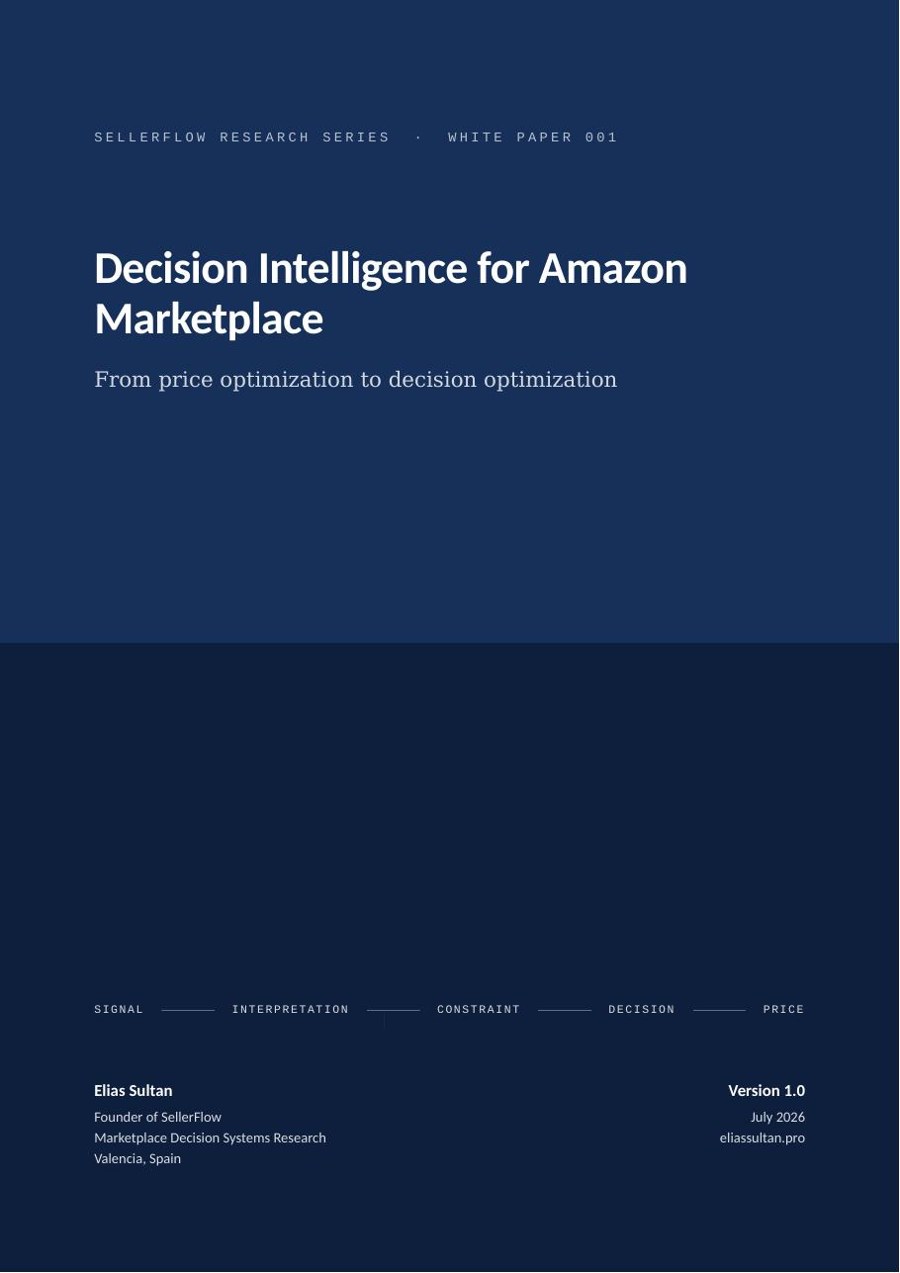
From price optimization to state- and context-based decision optimization
Amazon Marketplace is one of the most complex pricing environments in commerce. This paper argues that the difficulty is not primarily a pricing problem, and that treating it as one is why so much marketplace automation erodes margin while working exactly as designed.
Version 2.0 develops two properties the first version left implicit. State relativity: the commercial meaning of a signal is not a property of the signal but of the configuration the firm is in — the same price premium is associated with a materially different featured-offer outcome depending on delivery position, and a fixed monetary undercut is a large move on a cheap product and an imperceptible one on an expensive one. Decision dynamism: a prescription is a time-bounded object with an entry state, a horizon, an observable market response and a revision rule, in an environment where both the market and the deciding policy are non-stationary.
The unit of analysis is accordingly the full chain — state, action, market response, settled commercial outcome — and the paper distinguishes an observation from a decision, an accepted execution, a market response and a settled result. Every quantitative statement was re-derived directly from the operational database at a stated cut-off, with its unit of observation.
It also reports what the evidence does not support. A re-derived response surface is presented together with the selection bias that limits it; a change in the observation instrument inside the analysis window is documented rather than smoothed over; and the question of whether this approach performs better than conventional reactive repricing is posed as an open research question, not answered. Claims from Version 1.0 that could not be reproduced are listed as withdrawn in Appendix C.
Built on
Contents
Intended audience
Amazon Marketplace professionals; ecommerce technology companies; pricing specialists and marketplace consultants; software developers building commercial decision systems; and researchers working on pricing and decision-support methodologies.
Citation
In preparation
Each paper develops one component of the framework in depth.
Measuring competitor response intervals on Amazon and the strategic consequences of a market where reaction is not instantaneous.
Reconciling estimated against settled fees, and the effect of that gap on pricing floors across a live catalogue.
Architecture of a continuous, buyer-faithful record of marketplace offers, and why observation fidelity is the hard part.
Enquiries
Journalists, researchers and industry analysts can request pre-publication copies for review.
Contact